
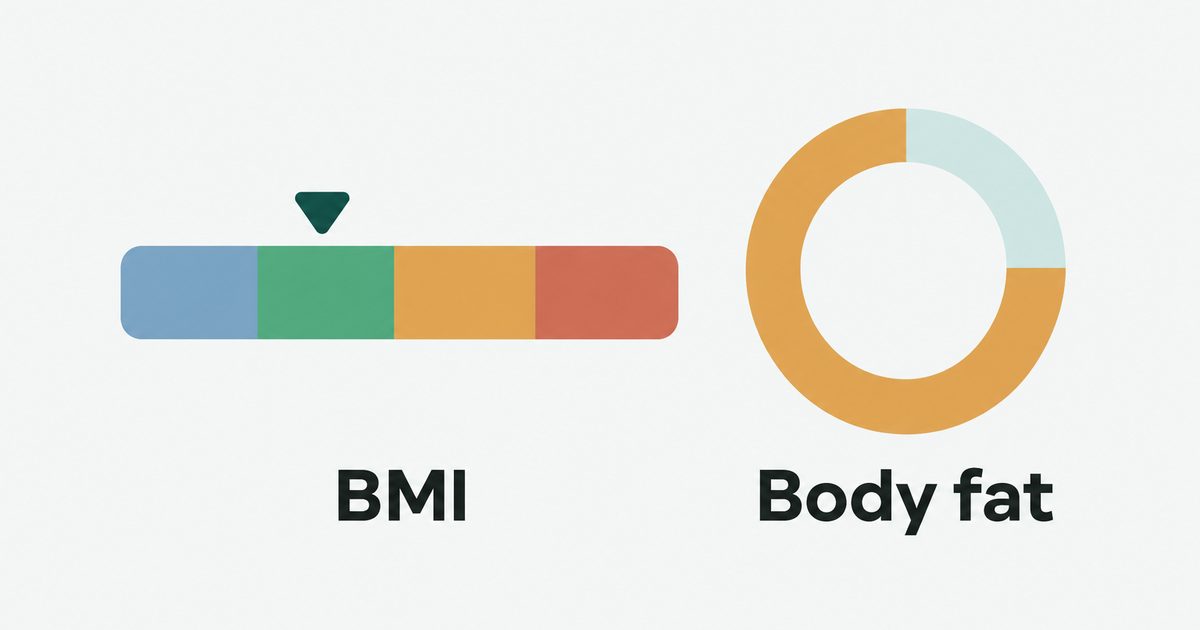
"Skinny fat": what normal weight obesity is
A normal BMI with a high body fat percentage has a research name. Here is what the 2010 study behind it found, and its limits.
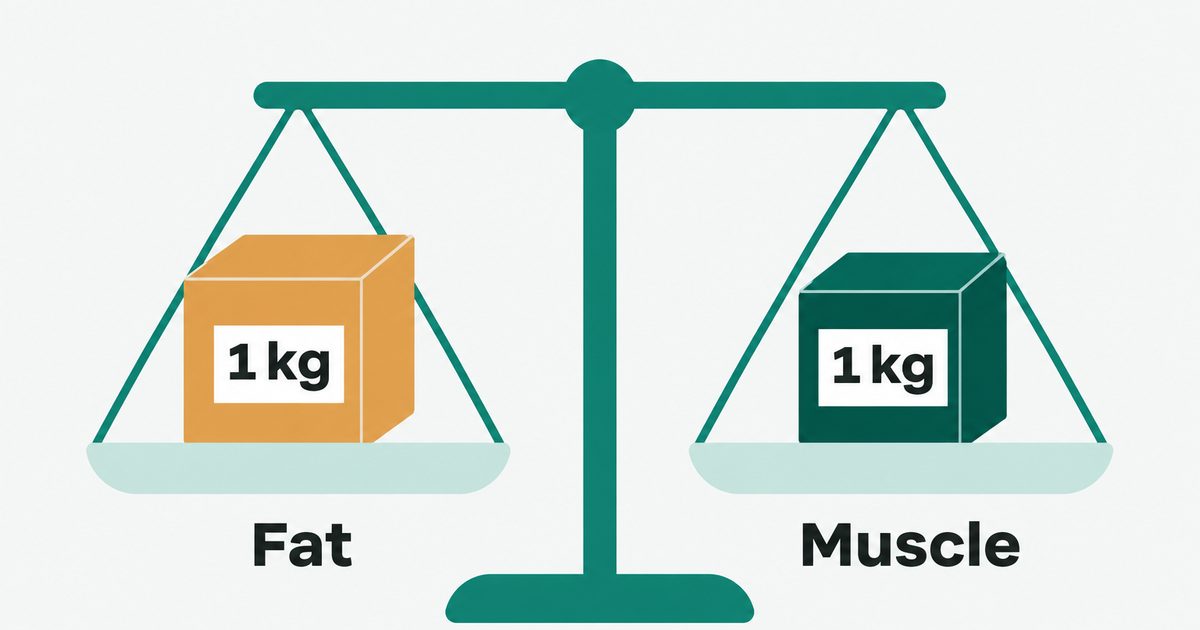
No. A kilogram of muscle and a kilogram of fat weigh exactly the same. The difference is density: body composition research assumes fat at 0.900 g/ml and fat-free tissue at 1.1 g/ml, so a kilo of fat takes up about 1,111 ml and a kilo of fat-free tissue about 909 ml. The same weight of muscle takes less space.
No. A kilogram of muscle weighs a kilogram, and so does a kilogram of fat. The question is really about density: how much space a given weight takes up. Muscle is denser than fat, so the same weight of muscle fills less room. That is why two people with the same weight can look and measure quite differently.
The numbers come from the scientists who worked out how to estimate body fat by weighing people underwater. To turn a whole-body density into a fat percentage, they had to assume a density for each part of the body.
William Siri, at the Donner Laboratory in Berkeley, set out those assumptions in a 1956 report (UCRL-3349), later reprinted as a 1961 book chapter. He split the body into two parts, fat and everything else (the fat-free body), and used these values:
| Component | Density Siri used | Volume of 1 kg |
|---|---|---|
| Fat, at 37 °C | 0.900 g/ml | about 1,111 ml |
| Fat-free body | 1.1 g/ml | about 909 ml |
From those two values Siri derived the equation still used with underwater weighing: body fat as a fraction of weight equals 4.950 divided by body density, minus 4.500.
A 2015 review in Obesity Reviews by Steven Heymsfield and colleagues confirms that Siri's two-part model became the one applied by most investigators, and notes that later researchers adjusted the fat value slightly, to 0.9007 g/ml at a mean body temperature of 36 °C. The same review lists the range used in the other two-part models published between 1945 and 1959: 0.889 to 0.918 g/ml for fat and 1.095 to 1.109 g/ml for fat-free mass. Every one of them puts fat below the density of water (about 1 g/ml) and fat-free tissue above it.
So the volumes in the table are the honest answer to the question. A kilo of fat takes up roughly 22 percent more space than a kilo of fat-free tissue.
Fat-free mass is a chemistry category. It is water, protein, mineral and glycogen from every organ, bone and muscle, added together. It is not a lump of muscle. And body fat, as Siri defined it, is pure extractable fat, while the fat you can pinch is adipose tissue, which also holds water and protein.
Both tissues have been measured more directly:
Taking muscle at 1.06 to 1.11 g/ml, one kilo occupies about 900 to 945 ml. Compared with a kilo of adipose tissue at about 1,055 ml, that is a difference of roughly 12 to 17 percent. Real, but smaller than the images of a small red block next to a large yellow one suggest.
A bathroom scale measures one thing: the pull of gravity on everything you are made of, plus what you last ate and drank. It cannot tell which tissue the number came from. If one kilo of fat were replaced by one kilo of muscle, the scale would show no change at all, while your body would take up slightly less space.
The scale also counts everything else on board, including what you have just eaten and drunk. A single weighing tells you your weight on that morning. A run of weighings, taken the same way, shows a trend in total weight, with no breakdown of what changed.
The first week of eating less can show a larger drop, partly because stored glycogen is held with water that leaves with it; how much weight can you lose in a week? explains why the weekly loss then slows.
A tape measure records size, and size depends on volume, which is where density shows up. Two people of the same height and weight can have different waist measurements, because the same weight is packed into a different volume and stored in different places.
The waist is the most useful single place to measure, because it reflects where weight sits. The waist to height ratio calculator divides your waist by your height, which removes the unfairness of comparing a tall person's waist with a short person's, and explains what each band of the result means. The number is only as good as the tape, so it is worth following the steps in how to measure your waist and using the same spot each time.
A tape around the waist measures two fat stores together, the layer under the skin and the fat around the organs; visceral fat vs subcutaneous fat shows which one the Framingham Heart Study linked more strongly to risk factors.
Body mass index (BMI) is your weight in kilograms divided by your height in metres squared. Weight is the only body measurement in it, so it inherits the scale's blind spot: a kilo of muscle and a kilo of fat raise BMI by the same amount. A heavily muscled person and a person carrying more fat can have the same BMI. The page is BMI accurate? covers what BMI does well at population level and the four things it cannot see in an individual.
A body fat estimate tries to split your weight into its two parts. The body fat calculator picks one of three published methods depending on which measurements you give it, and tells you which one it used. Two of the three take your waist, so they respond to changes in size that the scale misses. The third works from BMI, age and sex, so it shares BMI's inability to tell muscle from fat. Every one of them is an estimate from the outside of the body, and they can disagree with each other by a few points.
The two-part model rests on an assumption: that the fat-free body has the same density in everyone. Siri knew this was not exactly true. His report estimates that body fat worked out from density alone carries an uncertainty of about ±4 percent of body weight, falling to about ±2 percent when total body water is measured as well.
The 2015 Heymsfield review lists factors that change the make-up, and so the density, of fat-free mass: growth, pregnancy, race, the length of a fast and the presence of disease. Ward and Lieber's measurements came from preserved cadaver muscle, and the method of preservation alone moved the result from 1.055 to 1.112 g/ml. None of these figures describes your body precisely. They describe the average assumptions that body composition methods are built on.
None of this says anything about how fast muscle can be gained or fat lost. The density figures describe tissue, not change over time.
No. A pound is a pound. A pound of muscle and a pound of fat weigh exactly the same. Muscle is denser, so a pound of it takes up less space: using Siri's 1956 values of 0.900 g/ml for fat and 1.1 g/ml for fat-free tissue, the same weight of fat has about 22 percent more volume.
It depends on which figures are compared. Siri's model uses 0.900 g/ml for pure fat and 1.1 g/ml for the fat-free body. Measured tissue is closer together: adipose tissue at 0.948 g/ml in Siri's worked example, and human skeletal muscle at 1.055 to 1.112 g/ml in Ward and Lieber's 2005 cadaver samples. On those tissue figures, a kilo of adipose tissue takes about 12 to 17 percent more space than a kilo of muscle.
The scale only reports total weight. Size depends on volume, and the same weight can occupy a different volume if its make-up changes. It also includes whatever you have just eaten and drunk. A tape measure at the same spot each time, such as the waist, records size directly, which is information the scale does not have.
No. BMI uses weight and height only. A kilo of muscle raises it by exactly as much as a kilo of fat, so a muscular person can be placed in a higher BMI band. Adding a waist measurement or a body fat estimate gives information BMI cannot. If a reading worries you, a doctor can tell you which measurements are worth taking.
Every figure above comes from one of these. Check them.
A normal BMI with a high body fat percentage has a research name. Here is what the 2010 study behind it found, and its limits.
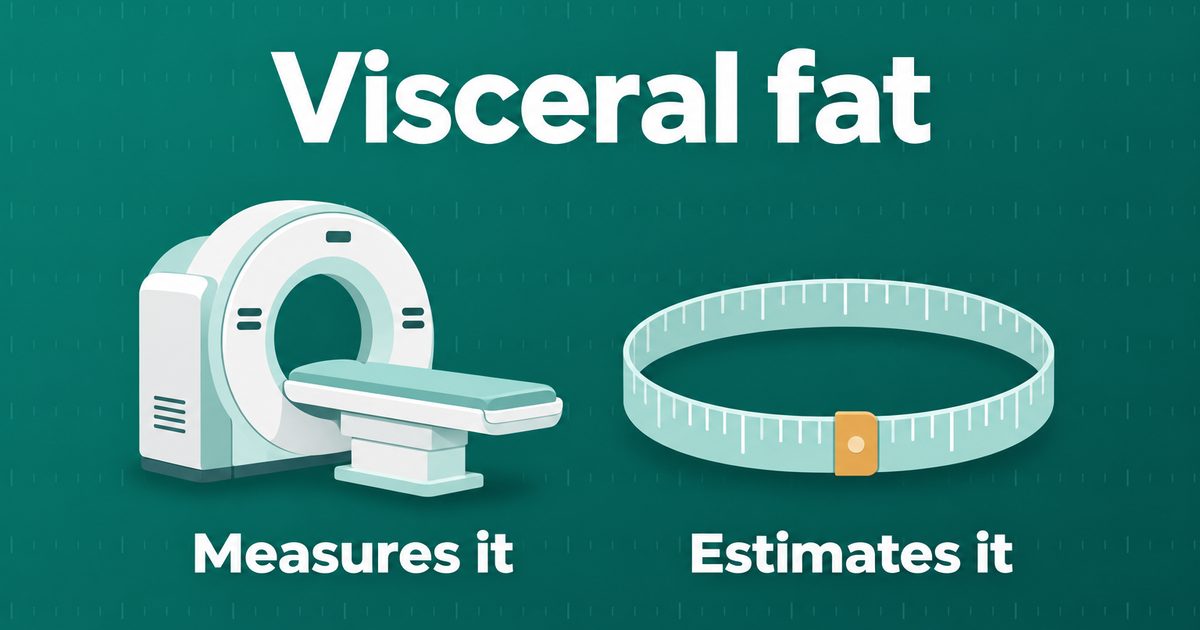
Fat under the skin and fat around the organs are measured differently and carry different risks. What the Framingham CT scans found.
A body fat scale measures resistance, then guesses fat with an equation you cannot see. What lab comparisons found, scale by scale.
The app runs body mass index (BMI), waist ratios and three body fat methods side by side, and tells you when they disagree about you.
Free, no account, and it works offline. 100,000+ downloads on Google Play.
This is not medical advice. Body Numbers is a calculator. It does not diagnose, treat or monitor any condition, and no number it produces should replace a conversation with a doctor or a dietitian. If a result worries you, or if you are pregnant, unwell, or under eighteen, speak to a health professional.
 Scan to install