
Body fat percentage calculator
An estimate of your body fat percentage by one of three published methods, chosen by the measurements you give it. With a waist and a neck, plus hips for a woman, the US Navy tape method (Hodgdon and Beckett, Naval Health Research Center, 1984). With a waist but not the rest, Relative Fat Mass (Woolcott and Bergman, Cedars-Sinai Medical Center, 2018). With no waist, the Deurenberg equation from your BMI, age and sex (Deurenberg, Weststrate and Seidell, Agricultural University Wageningen, 1991).
Which method the calculator used, and why
There is no single body fat formula. There are several, they need different measurements, and they disagree with each other by a few points. This calculator uses the best one your inputs support and tells you which, rather than quietly picking one.
| Method | Needs | Good for |
|---|---|---|
| US Navy | Height, waist, neck, and hip if you are female | The most informative of the three when you have a tape measure. Developed on a large military sample. |
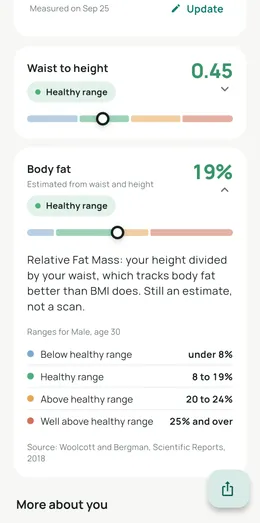
| Relative Fat Mass | Height and waist | Only two measurements, and it tracks whole body fat more closely than BMI does. Validated against DEXA scans. |
| Deurenberg | Height, weight, age, sex | No tape measure needed, and the widest error band of the three. A fallback, not a first choice. |
Healthy ranges by sex and age
These are Gallagher's cut points, the body fat percentages that correspond to BMI 18.5, 25 and 30 in a large study population. They rise with age, which is normal and expected.
| Age | Women, healthy | Men, healthy |
|---|---|---|
| Under 40 | 21 to 33% | 8 to 20% |
| 40 to 59 | 23 to 34% | 11 to 22% |
| 60 and over | 24 to 36% | 13 to 25% |
What these numbers cannot do
Every method here estimates fat from the outside of your body. None of them can see inside it. A DEXA scan, hydrostatic weighing or a BOD POD measure body composition directly and will disagree with this page, usually by a few percentage points and sometimes by more.
They also say nothing about where the fat is. Fat around the organs behaves differently from fat under the skin, and thewaist to height ratio is a better guide to that than any single percentage.
Treat a single reading as a starting point. Treat a series of readings, taken the same way, as information.
The same three methods, on your phone
The app runs all three, shows which one produced your number, explains what the method is, and cites the paper on the same screen. It also keeps past readings so you can see whether the number is moving.
Taking the tape measurement properly matters more than which formula you pick:where exactly to measure your waist.


Free, no account, and it works offline. 100,000+ downloads on Google Play.
Common questions
Which method should I use?
Whichever your measurements allow. With a waist and a neck measurement, the US Navy method is the most informative of the three, and women need a hip measurement too. With only a waist, Relative Fat Mass is better than anything BMI can give you. With no tape measure at all you get the Deurenberg estimate from BMI, age and sex, which has the widest error band of the three.
How accurate is a tape measure estimate?
Good enough to track a direction, not good enough to argue with a scan. Circumference methods typically land within a few percentage points of a DEXA scan for most people, and they drift furthest for the very lean and the very heavy. The useful question is whether your number is moving, measured the same way each time.
Why is my body fat high when my BMI is normal?
Because they measure different things. BMI knows only your weight and your height. A waist based estimate knows something about where that weight sits, and a person can be inside the healthy BMI band while carrying more fat than is ideal for their age. That combination is worth mentioning to a doctor rather than ignoring.
What is a healthy body fat percentage?
It depends on your sex and your age, and it rises with age. Using Gallagher's 2000 cut points, a man under 40 sits in the healthy band between 8 and 20 percent, and a woman under 40 between 21 and 33 percent. Both bands move up by a few points after 40 and again after 60.
Where do I measure my waist?
Standing, after breathing out, tape level and snug but not pulled tight, and not where your trousers sit. Which spot is an awkward question on this page in particular: the three methods here were fitted on different ones. The US Navy equation used the navel for men and the narrowest point for women, Relative Fat Mass came out of a survey that measures at the top of the hip bone, and the healthy bands all three are read against are Gallagher's, which are derived from BMI and have no waist landmark behind them at all. So no single spot is the right one here. Pick one, use it every time, and watch your own direction of travel rather than the absolute number.
Sources
Every figure above comes from one of these. Check them.
- Woolcott OO, Bergman RN (2018). Relative fat mass (RFM) as a new estimator of whole-body fat percentage. Scientific Reports 8, 10980
- Hodgdon JA, Beckett MB (1984). Prediction of percent body fat for U.S. Navy men from body circumferences and height. Naval Health Research Center, San Diego, Report No. 84-11
- Hodgdon JA, Beckett MB (1984). Prediction of percent body fat for U.S. Navy women from body circumferences and height. Naval Health Research Center, San Diego, Report No. 84-29
- Deurenberg P, Weststrate JA, Seidell JC (1991). Body mass index as a measure of body fatness: age- and sex-specific prediction formulas. British Journal of Nutrition 65(2)
- Gallagher D et al. (2000). Healthy percentage body fat ranges: an approach for developing guidelines based on body mass index. American Journal of Clinical Nutrition 72(3)
This is not medical advice. Body Numbers is a calculator. It does not diagnose, treat or monitor any condition, and no number it produces should replace a conversation with a doctor or a dietitian. If a result worries you, or if you are pregnant, unwell, or under eighteen, speak to a health professional.
