
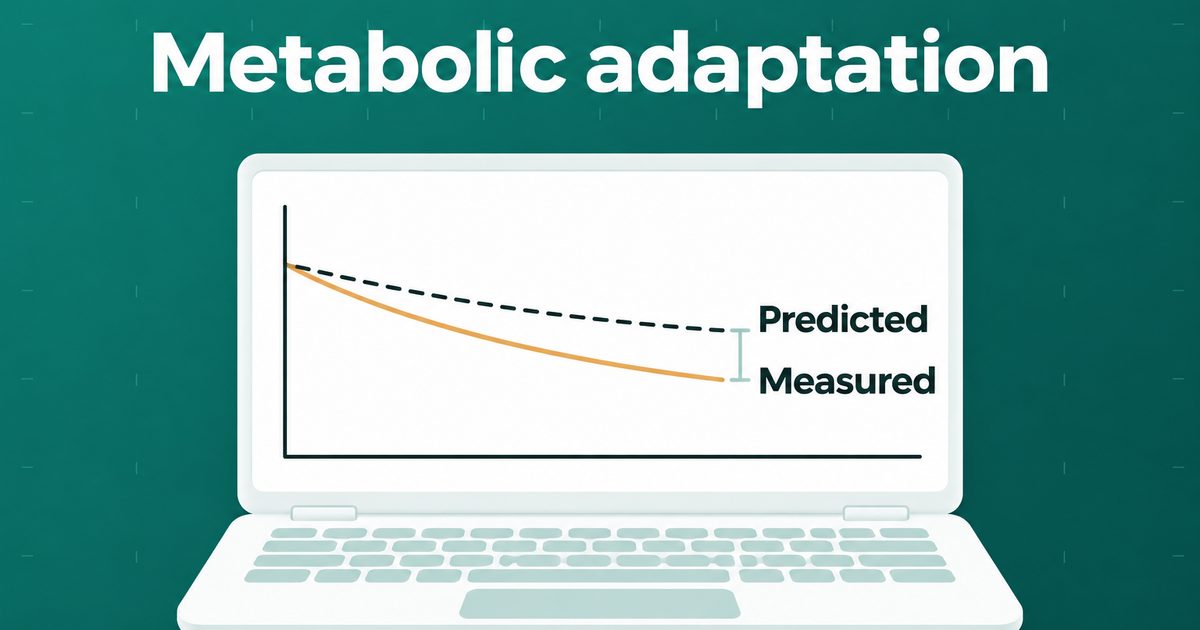
Metabolic adaptation: what studies found
From a 1995 NEJM experiment to The Biggest Loser follow-up: what metabolic adaptation studies measured, and what they cannot tell you.
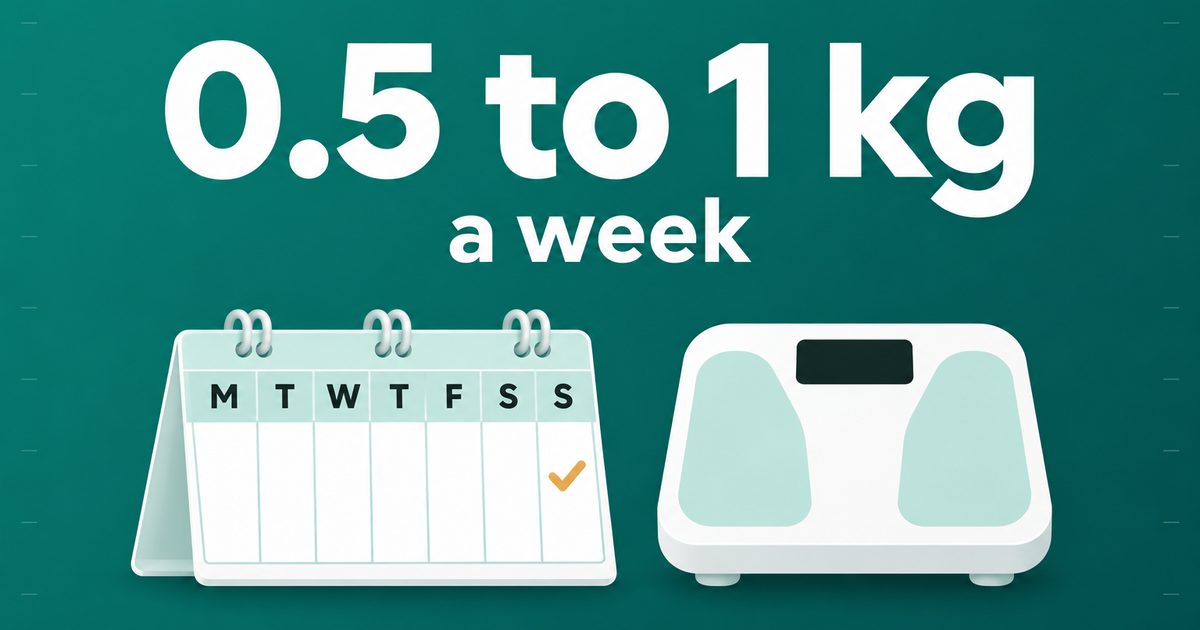
The National Health Service (NHS) says to aim to lose 1 to 2lbs, or 0.5 to 1kg, a week, and the US Centers for Disease Control and Prevention (CDC) gives the same 1 to 2 pounds. The first week can show more on the scale because stored glycogen is held with water, which is lost along with it. Over months, the weekly loss slows, because the body uses less energy as it gets lighter.
The short answer from official guidance is 1 to 2 pounds a week. The NHS page on overweight and obesity in adults puts it as "aim to lose 1 to 2lbs, or 0.5 to 1kg, a week", and the US Centers for Disease Control and Prevention (CDC) gives the same range. That figure is guidance on a pace, not a forecast of what any one person's scale will show. The first week can look very different from week ten, and there are clear physical reasons for both.
The NHS gives its range in two places on its website. The page "Overweight and obesity in adults" (last reviewed 29 April 2026) tells readers to try to lose weight steadily, and to "aim to lose 1 to 2lbs, or 0.5 to 1kg, a week". The page "Tips to help you lose weight" lists the same line, "aim to lose 1 to 2lbs, or 0.5 to 1kg, a week", among its dos.
The NHS weight loss plan, a 12-week PDF guide on the NHS website, describes the same range as "a safe and sustainable rate of 0.5kg to 1kg (1lb to 2lbs) a week".
The CDC page "Steps for Losing Weight" states that people "who lose weight at a gradual, steady pace" of about 1 to 2 pounds a week "are more likely to keep the weight off" than people who lose it faster.
| Source | Weekly range | Framing |
|---|---|---|
| NHS, Overweight and obesity in adults | 1 to 2lbs (0.5 to 1kg) | "try to lose weight steadily" |
| NHS weight loss plan (12-week guide) | 0.5kg to 1kg (1lb to 2lbs) | "safe and sustainable rate" |
| CDC, Steps for Losing Weight | about 1 to 2 pounds | "gradual, steady pace" |
A drop of more than 2 pounds after one week of eating less does not contradict the guidance above. A short 1992 report in the American Journal of Clinical Nutrition by Kreitzman, Coxon and Szaz explains a large part of why. Its title calls it the "illusion" of easy weight loss.
The body stores carbohydrate as glycogen, in the liver, the muscles and fat cells. According to the report, glycogen is stored "in hydrated form (three to four parts water)". When you eat less, the body draws on that glycogen early, and the water stored with it goes too. That water shows up on the scale as lost weight, but it is not body fat.
The same mechanism works in reverse. The authors describe an "exaggerated regain" when carbohydrate is eaten in large amounts again after dieting, as glycogen and its water are put back.
What this study cannot tell you:
So a large drop in week one does not mean that rate will continue.
Weight also rises and falls across the week: in a study of 1,421 adults it moved by 0.35%, higher after the weekend, and what is water weight? looks at salt and the menstrual cycle too.
One rule of thumb treats every pound of body weight as worth a fixed number of calories, so a fixed daily cut in food should remove the same amount of weight every week, forever. This post calls it the fixed rule.
A 2011 paper in The Lancet by Kevin Hall and colleagues at the US National Institutes of Health tested that idea with a mathematical model of adult metabolism. The paper calls this static rule "overly simplistic", because it ignores how the body's energy use changes as weight changes. A lighter body burns less energy at rest and less energy moving around, so the same intake produces a smaller gap each week.
What the paper found:
What this paper cannot tell you:
Harvard Health Publishing, in its 2024 article "Calorie counting made easy", states that calorie intake "should not fall below 1,200 a day in women or 1,500 a day in men, except under the supervision of a health professional." The same article describes losing 1 to 2 pounds a week as "a rate that experts consider safe".
The official sources name specific groups.
For anyone in these groups, the weekly range above is not the place to start. A doctor is.
The calorie deficit calculator lets you pick a pace up to 1 kg a week, the top of the NHS range. It projects your weight week by week and recalculates your energy needs at each new weight, so the curve bends and flattens the way the Hall paper describes, rather than running in a straight line. It stops the projection at a BMI of 18.5, the bottom of the healthy BMI range, and will not set a daily intake under 1,200 kcal for a woman or 1,500 kcal for a man, the Harvard Health floors.
That projection leaves out metabolic adaptation, a fall in energy use beyond what the smaller body predicts; metabolic adaptation: what studies found covers a six-year follow-up of 14 people in which it averaged 499 kcal a day.
The total daily energy expenditure (TDEE) calculator estimates how much energy you use in a day, from your age, sex, height, weight and activity level. Both give estimates. Neither can diagnose anything or tell you what weight is right for you.
The NHS says to aim to lose 1 to 2lbs, or 0.5 to 1kg, a week, and the CDC gives about 1 to 2 pounds a week. Harvard Health Publishing describes 1 to 2 pounds a week as "a rate that experts consider safe". These are general guidance for adults. Children, pregnant women, and people with a medical condition or an eating disorder (current or past) are advised by the NHS to get advice from a GP first.
Part of the early drop is water. A 1992 report in the American Journal of Clinical Nutrition by Kreitzman and colleagues describes glycogen, the body's stored carbohydrate, as held with three to four parts water. Eating less draws down glycogen early, and the water goes with it. That loss is not body fat, and the same rate is not expected to continue.
A 2011 modelling study in The Lancet by Hall and colleagues showed that body weight responds slowly to a lasting change in eating, with a half time of about a year, because a lighter body uses less energy. The fixed rule that treats each pound as a set number of calories predicts a straight line; the model predicts a curve that flattens.
Harvard Health Publishing states that calorie intake should not fall below 1,200 a day in women or 1,500 a day in men, except under the supervision of a health professional. The calorie deficit calculator on this site applies those same floors.
Every figure above comes from one of these. Check them.
From a 1995 NEJM experiment to The Biggest Loser follow-up: what metabolic adaptation studies measured, and what they cannot tell you.
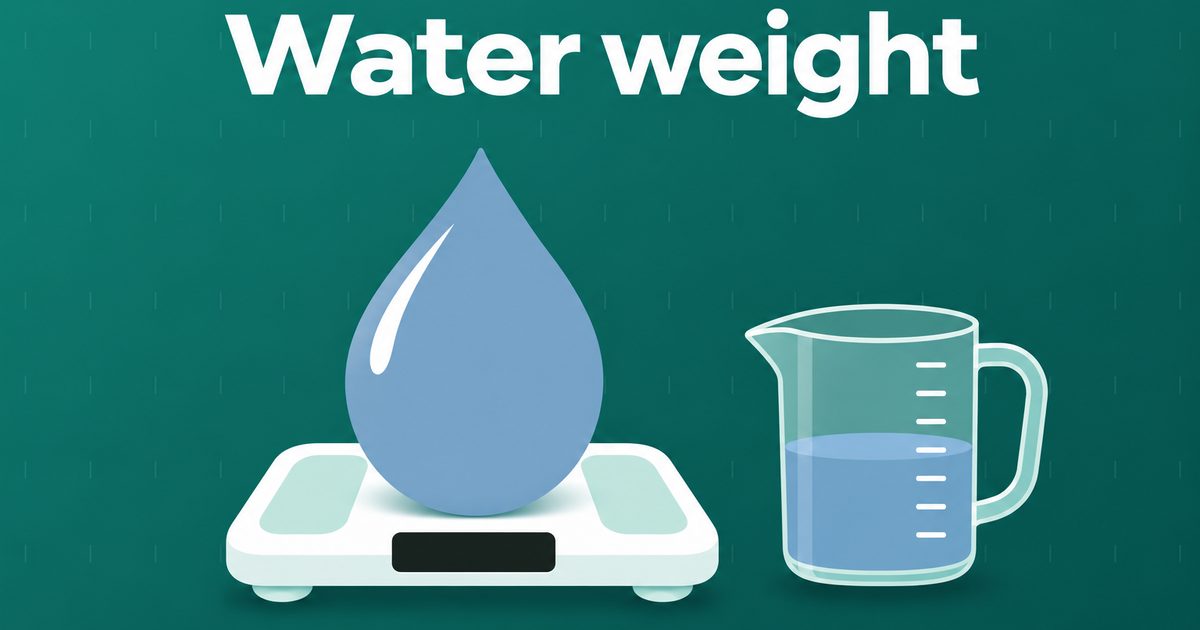
Body water, glycogen and the weekly cycle all move the scale. What the studies measured, and why a trend says more than one weigh-in.
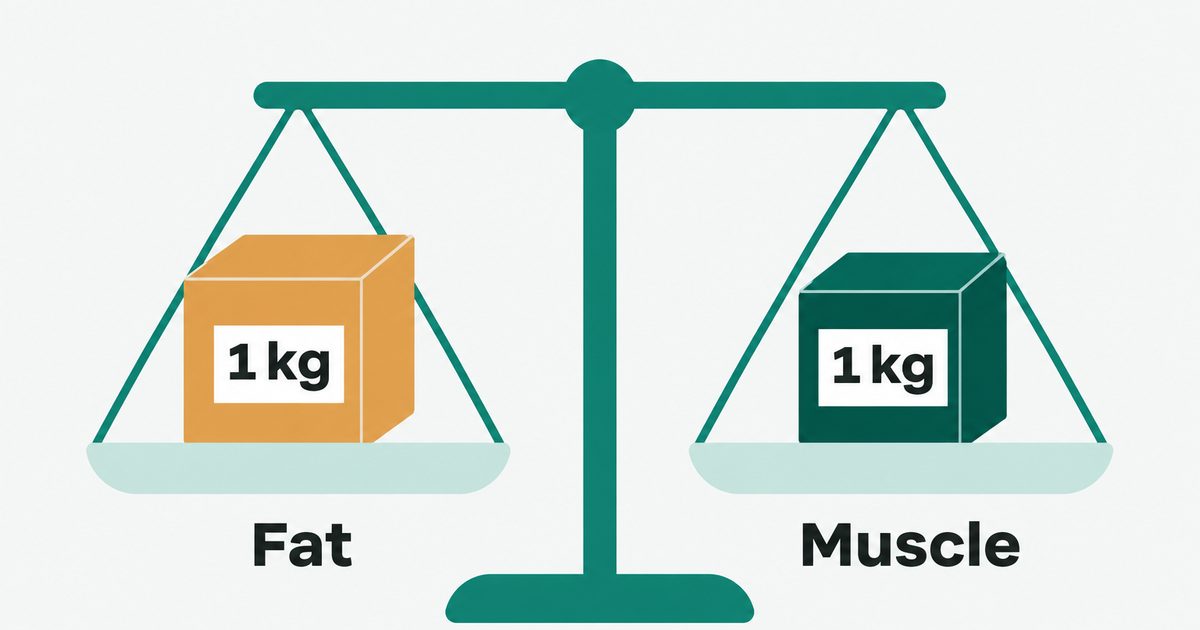
A kilo is a kilo. The real difference is density: the same weight of muscle takes less room than fat. Here are the figures and where they come from.
The app runs body mass index (BMI), waist ratios and three body fat methods side by side, and tells you when they disagree about you.
Free, no account, and it works offline. 100,000+ downloads on Google Play.
This is not medical advice. Body Numbers is a calculator. It does not diagnose, treat or monitor any condition, and no number it produces should replace a conversation with a doctor or a dietitian. If a result worries you, or if you are pregnant, unwell, or under eighteen, speak to a health professional.
 Scan to install