
TDEE calculator
The calories you burn in a day, from Mifflin St Jeor, the most reliable resting equation in a 2005 review of the four most used. The resting figure is shown separately, so you can see where the number comes from.
How the number is built
Two steps. First your resting metabolic rate, the energy you would burn lying still all day, from the Mifflin St Jeor equation. Then a multiplier for how much you move.
| Activity level | Multiplier | What it actually means |
|---|---|---|
| Sedentary | 1.2 | Desk job, little deliberate exercise |
| Lightly active | 1.375 | Exercise 1 to 3 days a week |
| Moderately active | 1.55 | Exercise 3 to 5 days a week |
| Very active | 1.725 | Hard exercise 6 to 7 days a week |
| Extremely active | 1.9 | Physical job, or training twice a day |
The resting half of this is the well validated half. The multiplier is a convention, and it is where most of the error lives. If your weight is not doing what the number predicts after three or four weeks, adjust the multiplier rather than doubting the arithmetic.
Turning it into a target
Eating below your TDEE loses weight and above it gains. About 500 kcal a day either way moves roughly half a kilo a week. That is deliberately unspectacular: it is the pace that holds, and the one that costs the least lean mass on the way down.
To pick a pace and see where it leads week by week, use thecalorie deficit calculator. It also shows why the loss slows as you go.
If you want the split between carbohydrate, protein and fat, themacro calculator takes the same inputs.
The same calculation, on your phone
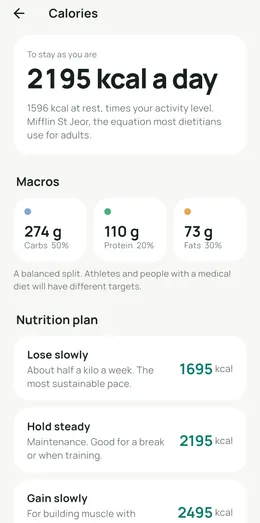
The app shows your resting rate, your daily energy and the three plans side by side, and keeps them updated as your weight changes.


Free, no account, and it works offline. 100,000+ downloads on Google Play.
Common questions
What is TDEE?
Total daily energy expenditure: everything you burn in a day. It is your resting metabolic rate, which is most of it, plus the energy used moving around, exercising and digesting food. The calculator estimates the resting part from a published equation and multiplies it by an activity factor.
How accurate is it?
It is an estimate with real error bars. Of the four most used resting equations (Harris Benedict, Mifflin St Jeor, Owen, and the WHO, FAO and UN University equation), a 2005 review found Mifflin St Jeor predicted resting energy to within 10 percent of the measured figure for more people than any of the others, though it can still be well out for one person. The activity multiplier is the rougher half, because it rests on your own guess at how active you are. Use the number as a starting point, then adjust based on what actually happens to your weight over a few weeks.
Which activity level should I pick?
Most people overestimate. A desk job with a couple of gym sessions a week is lightly active, not very active. If your weight is not moving the way the calculator suggests it should, the activity multiplier is the most likely culprit.
How big a deficit should I run?
About 500 kcal a day below your TDEE gives roughly half a kilo a week, which is the pace most people can actually sustain and the one most health services suggest. Larger deficits are harder to keep, cost more lean mass, and are not something to attempt without advice if you have any medical condition.
Why does this differ from another TDEE calculator?
Calculators use different resting equations and different activity multipliers, and either one changes the answer. Mifflin St Jeor, Harris Benedict and Katch McArdle give different resting figures for the same person, and Katch McArdle needs a body fat estimate as well. This page uses Mifflin St Jeor, which a 2005 systematic review of the four most used resting equations (Harris Benedict, Mifflin St Jeor, Owen, and the WHO, FAO and UN University equation) found the most reliable.
Sources
Every figure above comes from one of these. Check them.
- Mifflin MD, St Jeor ST, Hill LA, Scott BJ, Daugherty SA, Koh YO (1990). A new predictive equation for resting energy expenditure in healthy individuals. American Journal of Clinical Nutrition 51(2)
- Frankenfield D, Roth-Yousey L, Compher C (2005). Comparison of predictive equations for resting metabolic rate in healthy nonobese and obese adults: a systematic review. Journal of the American Dietetic Association 105(5)
- NHS: Tips to help you lose weight, including the 0.5 to 1 kg a week guideline
This is not medical advice. Body Numbers is a calculator. It does not diagnose, treat or monitor any condition, and no number it produces should replace a conversation with a doctor or a dietitian. If a result worries you, or if you are pregnant, unwell, or under eighteen, speak to a health professional.
