
Metabolic age: what the number is
Your scale says your body is 38. Where that number comes from, what studies have done with it, and what no one has standardised.
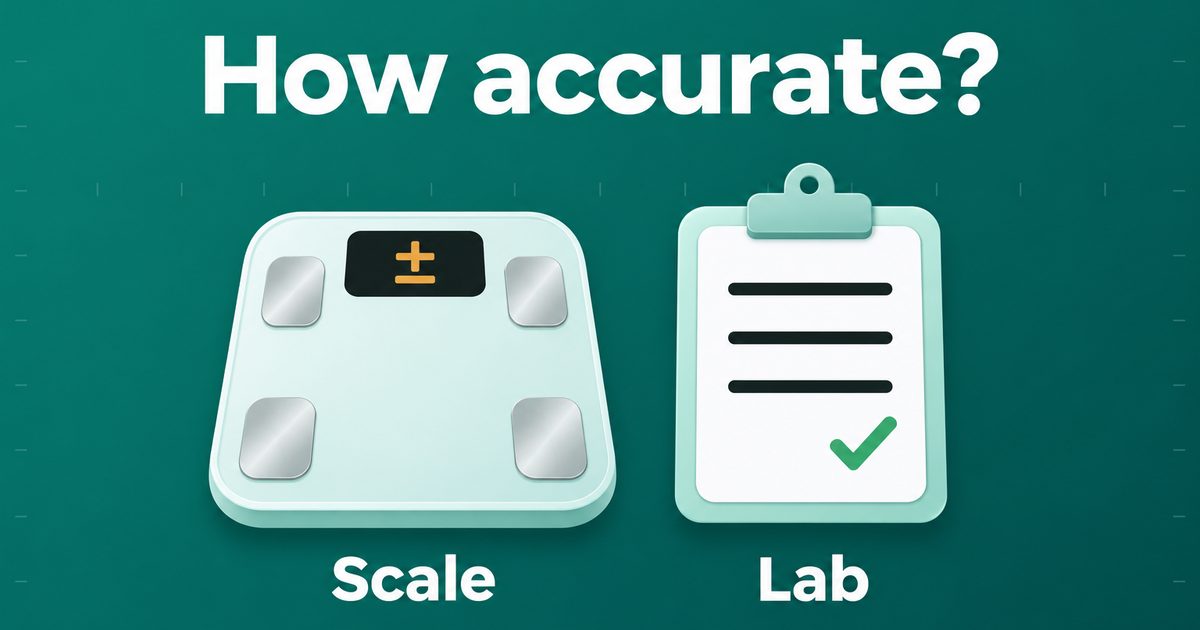
Home body fat scales are close for some people and several points off for others. In a 2023 study of fifteen devices against a four-compartment lab model, average errors ranged from 3.5% too low to 11.7% too high (one foot-to-foot scale), and only four of the fourteen consumer models agreed with the lab model within 2%. The same study found that several devices tracked change over 12 to 16 weeks more closely than they measured body fat on a single day.
A body fat scale does not see fat. It measures how hard it is for a weak electric current to pass through your legs, then feeds that number, with your height, age and sex, into a prediction equation. In lab comparisons, some home scales came within 1% of the reference on average, and one was off by more than 11%.
The method is called bioelectrical impedance analysis, or BIA. A 2025 review in Current Opinion in Clinical Nutrition and Metabolic Care by Dupertuis and colleagues at Geneva University Hospitals describes it: the device sends a low-intensity alternating current, under 1 mA, through the body. The current flows through water-rich, electrolyte-rich tissue and is held back by fat. In a normally hydrated person, impedance (the resistance to that current) rises as body fat rises.
On a bathroom scale, the current runs through metal pads under your feet (foot-to-foot). Handheld devices use hand-to-hand. Octopolar devices add handles, with electrodes on each hand and foot. A single-frequency device, working at 50 kHz, then estimates fat-free mass and fat mass "using predictive equations incorporating sex, age, height, and weight" (Dupertuis 2025).
The 2004 guidelines from the European Society for Clinical Nutrition and Metabolism (ESPEN), by Kyle and colleagues in Clinical Nutrition, set out when BIA works: with an equation that suits the person's population, age or health condition, set procedures, and no significant fluid or electrolyte problems.
Home scales make that condition hard to check. The 2025 Dupertuis review says consumer single-frequency devices "often lack raw data access, clinical validation, and regulatory certification", and that their reliance on proprietary algorithms limits their transparency. It adds that results from devices that rely on "proprietary, undisclosed equations" may not suit a given group of people. Without the equation, you cannot tell whether the people it was built on resemble you.
The studies below compare scales with dual-energy X-ray absorptiometry (DXA), an X-ray scan that splits the body into fat, lean tissue and bone, and the four-compartment model, which combines body weight, body volume, bone mineral and total body water (as used by Siedler 2023). Differences are in body fat percentage points unless a study reports kilograms.
A 2023 study in the British Journal of Nutrition by Siedler and colleagues at Texas Tech University. tested 73 healthy adults aged 19 to 50 on fourteen consumer devices priced at about $24 to $349 (ten foot-to-foot, one hand-to-hand, three octopolar) and one research-grade octopolar device, against a four-compartment model.
The authors suggest, as possibilities, outputs restricted toward a "normal" reading or an equation built on a narrow group of people, and write that people further from the average "should generally be more sceptical" of a consumer device's number.
These three studies show the same two things: a small average error for a group and a wide spread for individuals.
| Study | Who | What it found |
|---|---|---|
| Lloret Linares et al., 2011, Obesity Surgery | 5,740 patients at a Paris clinical nutrition department, average body mass index (BMI) 37.7, one leg-to-leg scale against DXA | The scale overestimated fat mass by 1.1 ± 6.1 kg, or 0.8 ± 5.6%. The authors describe the limits of agreement as wide. |
| Boneva-Asiova and Boyanov, 2008, Diabetes, Obesity and Metabolism | 159 women and 124 men in Sofia, one leg-to-leg analyser against DXA | Group results did not differ significantly. In leaner people the scale tended to read lower body fat than DXA; above a BMI of 35 the direction reversed. Agreement was better in men than in women and worsened as BMI rose. |
| Nickerson et al., 2019, Journal of Strength and Conditioning Research | 33 male college athletes, one foot-to-foot scale against a three-compartment model | Group averages did not differ significantly, but the 95% limits of agreement were ±5.67% for body fat, with proportional bias. The authors conclude the scale was not valid for individual body fat estimates. |
ESPEN Part II (2004) said BIA "works well" in healthy people with stable fluid balance and a suitable equation, but could not be recommended for routine use at extremes of BMI or with abnormal hydration without further validation.
Because the current follows body water, anything that moves water can move the number.
The same Siedler study also tested whether devices could follow change. Thirty-seven participants came back 12 to 16 weeks later.
A 2007 study in the International Journal of Obesity by Jebb and colleagues in Cambridge followed 58 women through 12 weeks of weight loss and then a year. Against multi-compartment models, one leg-to-leg device's estimate of fat change had a bias of 0.51 ± 3.26 kg (bias ± 2 sd) during loss and -0.25 ± 2.30 kg during regain. Not every study agrees: in Lloret Linares 2011, the scale overestimated fat loss after gastric bypass by 2.9 kg at 3 months and 1.9 kg at 12 months.
Siedler and colleagues suggest measuring each morning after an overnight fast from food and fluid, after using the toilet, in minimal clothing; tracking a multi-day average rather than single readings; and using the same device every time.
On immediate re-tests, a change of at least 1.4% was beyond the measurement noise of every device. The authors add that day-to-day changes in the body would push that threshold higher. Five foot-to-foot scales gave near-identical numbers when stepped on twice in a row, which the authors suggest may be a built-in limit rather than true precision.
The body fat calculator on this site uses published equations based on height, weight, age and tape measurements, not a current. Each was fitted against a different lab method, which why body fat calculators disagree explains. For a tape, as for a scale, measure the same way each time; how to measure your waist sets out the steps.
It depends on the device and the person. In a 2023 test of fourteen consumer devices against a four-compartment lab model, average errors ranged from 3.5% too low to 11.7% too high, and only four consumer models were equivalent to the lab model within 2%. A 2019 study of male athletes found limits of agreement of ±5.67% for one foot-to-foot scale.
Changes in body water move it. In a 2015 study, a meal or an electrolyte drink raised foot-to-foot body fat by a median of about 1%. A 2023 study suggests measuring in the morning after an overnight fast and tracking a multi-day average.
Some can, under the same conditions each time. In a 2023 study, nine of fifteen devices matched a lab model's change over 12 to 16 weeks within 1%, while seven showed a bias in the change they reported. A 2011 study in people after gastric bypass found one scale overestimated fat loss.
Neither is a lab measurement. A scale estimates fat from electrical resistance through an equation the maker does not publish; a calculator uses published equations built from tape measurements, height, weight and age. With either one, measuring the same way each time is what makes your own numbers comparable from one week to the next.
Every figure above comes from one of these. Check them.
Your scale says your body is 38. Where that number comes from, what studies have done with it, and what no one has standardised.
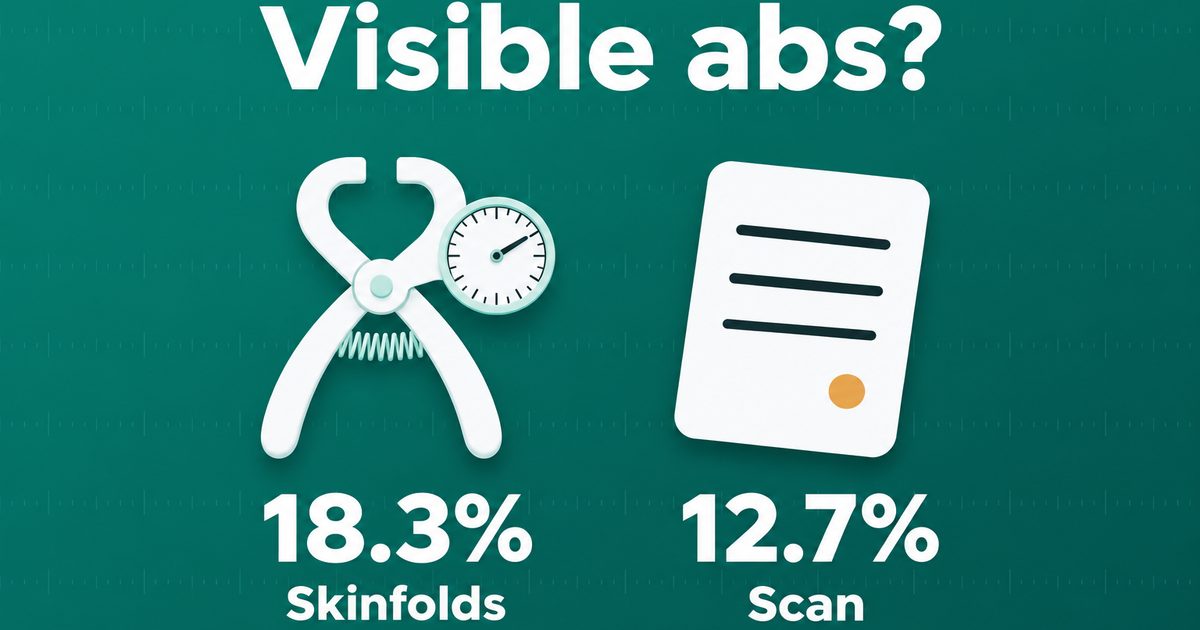
There is no researched abs threshold. Fat placement and the measuring method both move the number, and very low body fat has measured costs.
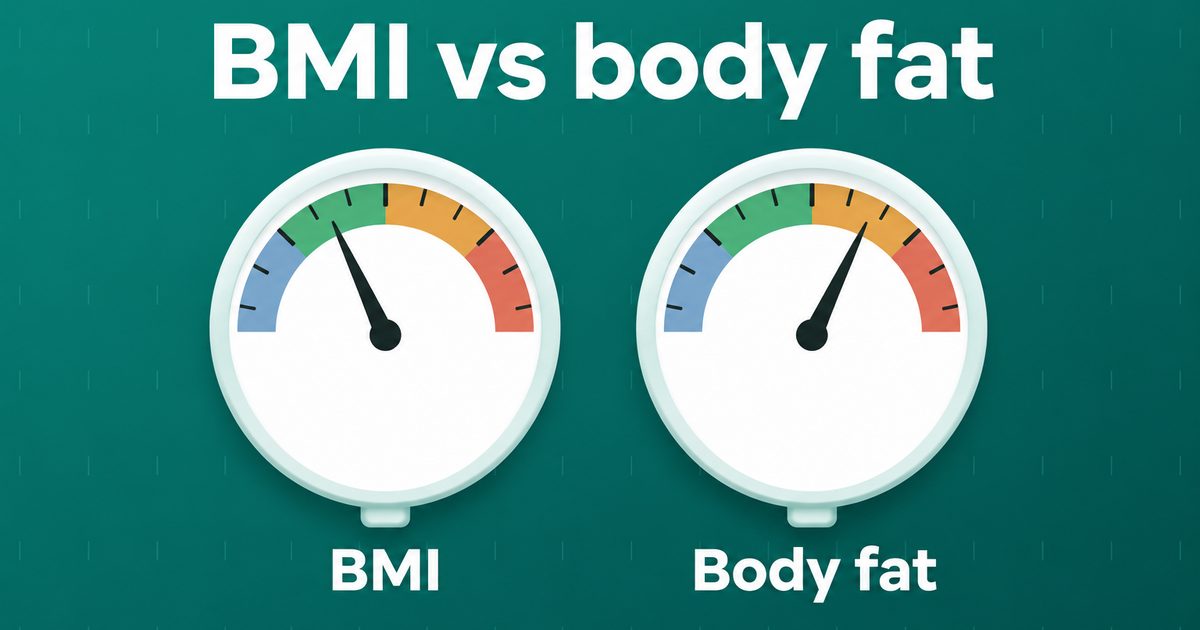
What BMI and body fat percentage each measure, and how often a BMI of 30 or over agrees with body fat measured in a lab.
The app runs body mass index (BMI), waist ratios and three body fat methods side by side, and tells you when they disagree about you.
Free, no account, and it works offline. 100,000+ downloads on Google Play.
This is not medical advice. Body Numbers is a calculator. It does not diagnose, treat or monitor any condition, and no number it produces should replace a conversation with a doctor or a dietitian. If a result worries you, or if you are pregnant, unwell, or under eighteen, speak to a health professional.
 Scan to install