
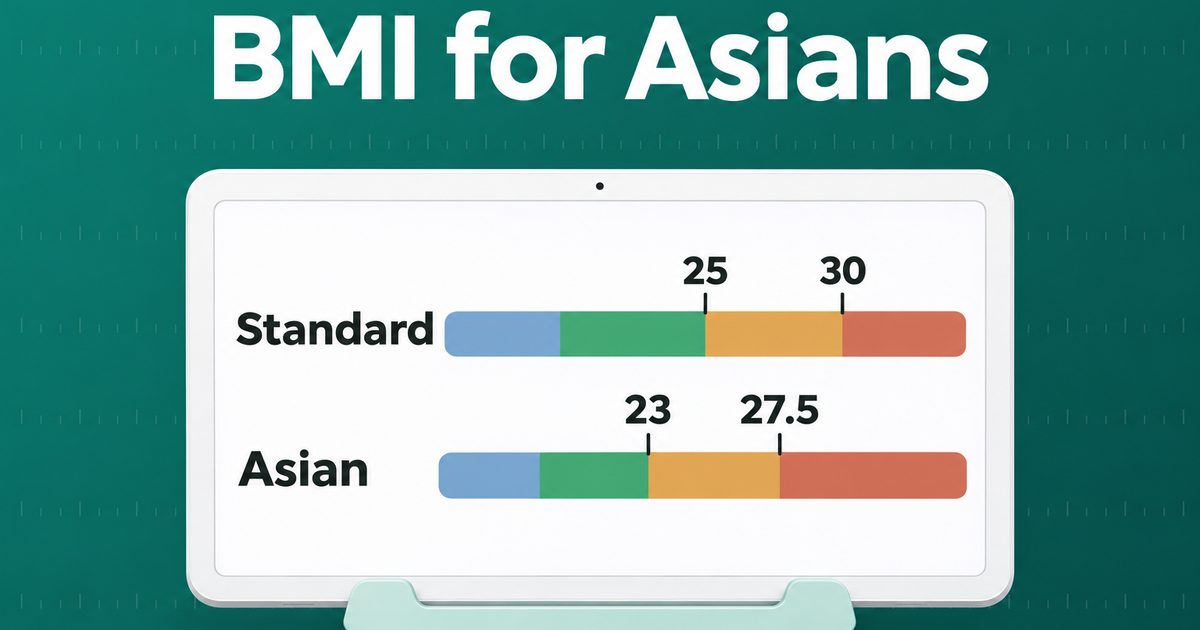
BMI for Asians: what the WHO actually said
The 2004 WHO consultation behind the 23 and 27.5 BMI numbers: what it weighed, what it proposed, and what it left to each country.
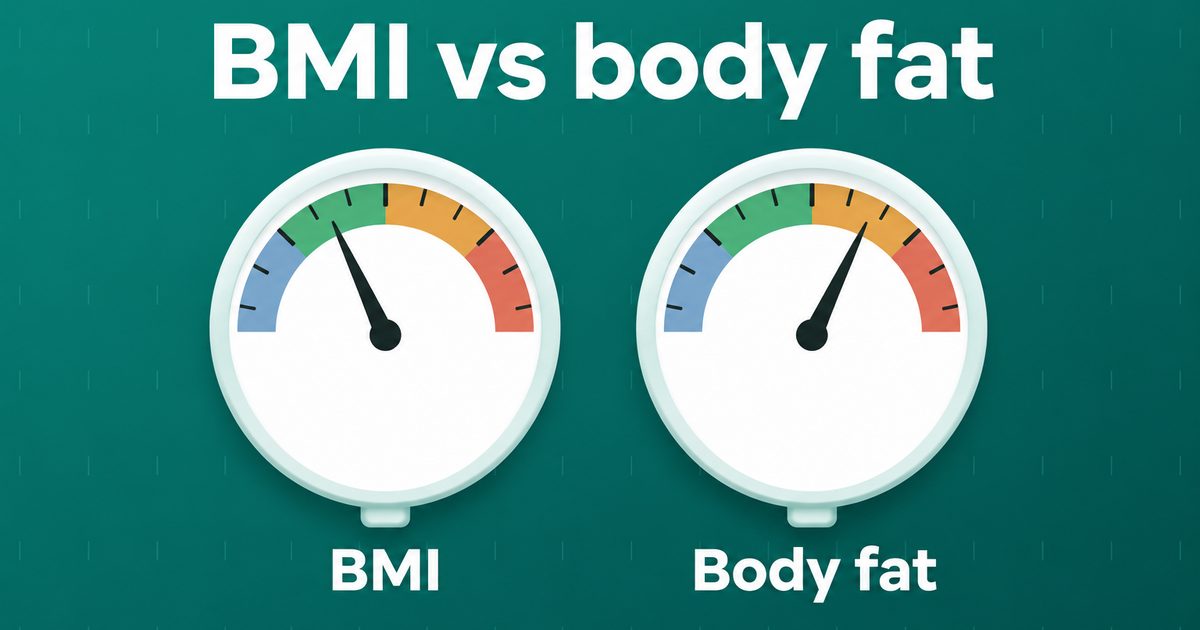
Body mass index (BMI) is weight divided by height squared; body fat percentage is the share of your weight that is fat. They agree only loosely. A 2010 meta-analysis of 31,968 people in the International Journal of Obesity found that BMI obesity cut-offs picked up half of the people whose measured body fat was high, while rarely flagging people whose body fat was not high.
BMI and body fat percentage answer two different questions. BMI asks how heavy you are for your height. Body fat percentage asks how much of that weight is fat. The two move together across large groups of people, but for one person they can tell different stories, and a 2010 meta-analysis put a number on how often.
BMI is your weight in kilograms divided by your height in metres squared. It needs a scale and a tape measure, nothing else. The cut-offs set by the World Health Organization and the US National Institutes of Health are: under 18.5 is underweight, 25 or over is overweight, and 30 or over is obesity. You can work yours out with the BMI calculator.
Body fat percentage is the fat in your body as a share of your total weight. Two people with the same weight can carry very different amounts of fat, because the rest of the weight is muscle, bone, organs and water. BMI cannot tell those apart. Body fat percentage is an attempt to measure the fat part directly.
In research, body fat is measured with what are called reference methods. In the 2000 study by Gallagher and colleagues in the American Journal of Clinical Nutrition, the reference methods were a four-compartment model at two laboratories and dual-energy X-ray absorptiometry (DXA) at all three laboratories. DXA is a low-dose X-ray scan that separates fat, lean tissue and bone.
Outside a lab, body fat is estimated, not measured. The estimates use things you can measure yourself:
The body fat calculator on this site uses one of three estimating equations depending on what you enter, and why those equations give different answers for the same person is covered in why body fat calculators disagree.
The clearest answer comes from Okorodudu and colleagues, a systematic review and meta-analysis published in 2010 in the International Journal of Obesity. The team searched databases including MEDLINE, EMBASE and Scopus, found 3,341 potentially relevant abstracts, and kept 25 studies that tested BMI against body fat measured with a body composition technique. Together those studies covered 32 samples and 31,968 people.
Two numbers sum up the result.
| Measure | BMI obesity cut-offs used in the studies | BMI 30 or over only |
|---|---|---|
| Pooled sensitivity | 0.50 (95% CI 0.43 to 0.57) | 0.42 (95% CI 0.31 to 0.43) |
| Pooled specificity | 0.90 (95% CI 0.86 to 0.94) | 0.97 (95% CI 0.96 to 0.97) |
The confidence intervals are copied as the abstract gives them.
Sensitivity is the share of people who really have high body fat that the test catches. A sensitivity of 0.50 means that out of 100 people whose measured body fat was high, BMI labelled about 50 as obese. The other 50 had a BMI under the cut-off and were missed.
Specificity is the share of people who do not have high body fat that the test correctly leaves alone. A specificity of 0.90 means that out of 100 people whose measured body fat was not high, BMI correctly left about 90 out of the obese group and wrongly put about 10 into it.
Put plainly: when BMI says obesity, it is right most of the time. When BMI says no obesity, that is much less reliable. The authors' own conclusion was that the BMI cut-offs "fail to identify half of the people with excess BF%".
A 2008 study by Romero-Corral and colleagues, also in the International Journal of Obesity, looked at 13,601 US adults aged 20 to 79 from the Third National Health and Nutrition Examination Survey. Body fat was estimated by bioelectrical impedance, and obesity by body fat was defined as more than 25% in men and more than 35% in women.
Bioelectrical impedance is itself an estimate, not a reference method like DXA, so this study is less direct than the meta-analysis. Its pattern is the same: high specificity, low sensitivity.
Age and sex change how much fat sits behind a given BMI. The Deurenberg adult formula shows this in plain arithmetic:
Body fat % = 1.20 × BMI + 0.23 × age - 10.8 × sex - 5.4 (sex is 1 for men, 0 for women)
At the same BMI and age, the formula gives a woman 10.8 percentage points more body fat than a man. Each extra 10 years of age adds 2.3 points. For a BMI of 25:
| Person | Estimated body fat |
|---|---|
| Man, 30 | 20.7% |
| Woman, 30 | 31.5% |
| Man, 60 | 27.6% |
| Woman, 60 | 38.4% |
These are formula estimates with a typical error of 4.1 points either way, and the paper reports the formula slightly overestimates body fat in people with obesity. They show the direction of the effect, not anyone's actual body fat.
If BMI and body fat do not line up neatly, what counts as a healthy body fat percentage? In 2000, Gallagher and colleagues wrote that no accepted published ranges of body fat percentage existed. Their approach was to borrow the BMI cut-offs and translate them.
They measured 1,626 adults with a BMI of 35 or less, from white, African American and Asian groups, at universities in Cambridge (United Kingdom), Columbia (United States) and Jikei (Japan). They then built equations predicting body fat from BMI, with sex, age and ethnic group as further predictors. The equations' standard errors ran from 2.8 to 5.4 percentage points of body fat. Feeding in BMI 18.5, 25 and 30 gave matching body fat values, separately by sex and age.
Two limits matter. The authors called the results provisional ranges and described their work as groundwork for international ranges, not final standards. And because the ranges are derived from BMI cut-offs, they inherit whatever those cut-offs get wrong. The body fat calculator on this site uses these ranges, by age and sex.
BMI is quick and needs no tape technique, so it is a reasonable first number. A body fat estimate adds information BMI cannot give, but outside a lab it is also an estimate with its own error. Neither one is a measurement of health on its own, and neither identifies any condition. If your BMI and a body fat estimate point in different directions, that is worth mentioning to a doctor. For the wider question of where BMI falls short beyond body fat, see is BMI accurate?.
They measure different things. Body fat percentage gets closer to what BMI is used as a stand-in for, which is the amount of fat. Outside a lab, though, body fat is estimated from tape measurements or from BMI itself, and those estimates carry errors of several percentage points. The Deurenberg adult equation, for example, has a typical error of 4.1 points.
Yes. In the 2010 meta-analysis by Okorodudu and colleagues, BMI obesity cut-offs caught only half of the people whose measured body fat was high. The rest had a BMI below the obesity cut-off. A 2008 study of 13,601 US adults found the same pattern and found BMI did worse with age.
Sensitivity is how many people with high body fat BMI correctly flags. Specificity is how many people without high body fat BMI correctly leaves unflagged. The 2010 meta-analysis found a pooled sensitivity of 0.50 and a pooled specificity of 0.90, so BMI rarely flags people wrongly but misses about half of those with high body fat.
In research, with reference methods such as dual-energy X-ray absorptiometry (DXA), a low-dose X-ray scan, or a four-compartment model. Gallagher and colleagues used both in their 2000 study. Calculators that use a tape measure or BMI estimate body fat from equations fitted against methods like these.
Every figure above comes from one of these. Check them.
The 2004 WHO consultation behind the 23 and 27.5 BMI numbers: what it weighed, what it proposed, and what it left to each country.
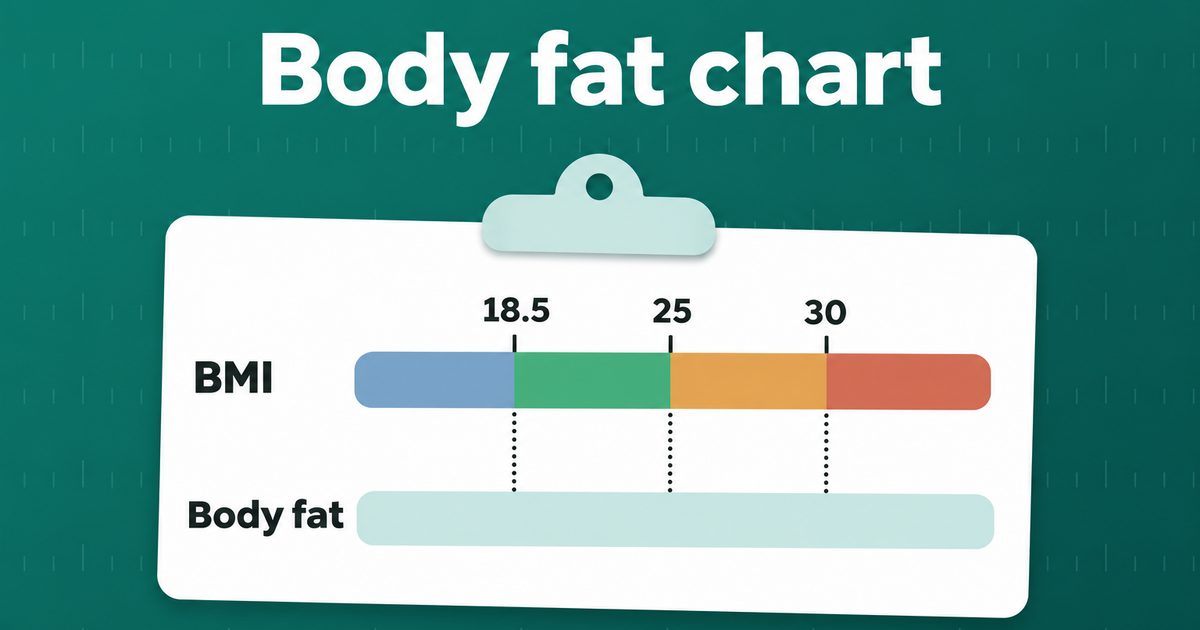
Two popular body fat charts, one 2000 study, and what each one actually rests on, with separate sections for women and for men.
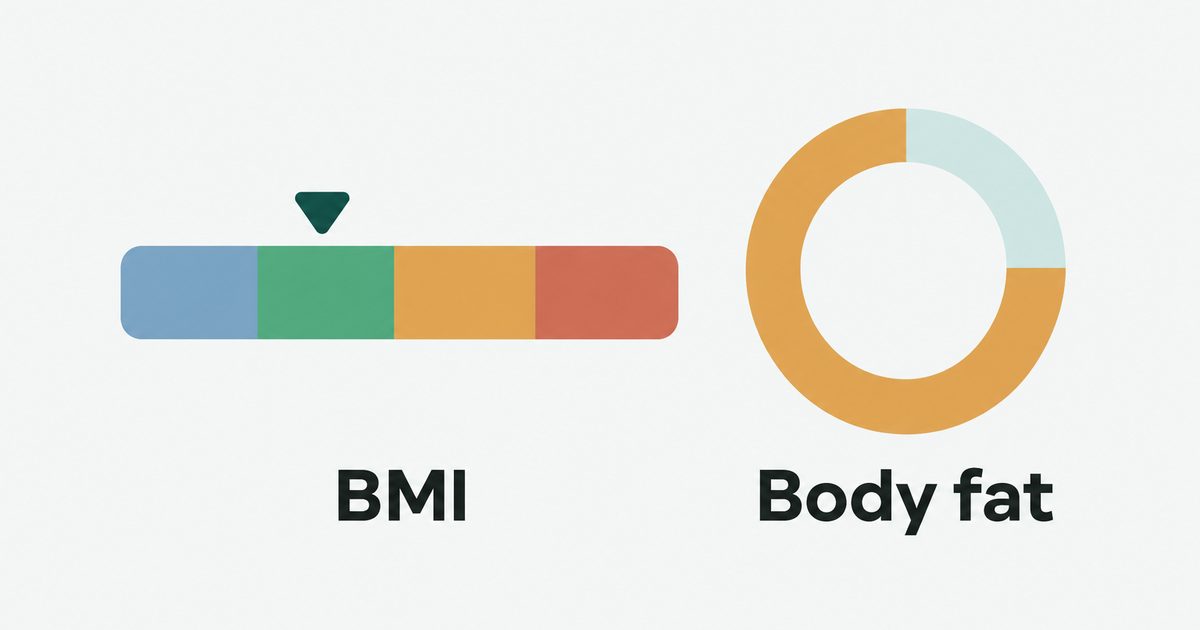
A normal BMI with a high body fat percentage has a research name. Here is what the 2010 study behind it found, and its limits.
The app runs body mass index (BMI), waist ratios and three body fat methods side by side, and tells you when they disagree about you.
Free, no account, and it works offline. 100,000+ downloads on Google Play.
This is not medical advice. Body Numbers is a calculator. It does not diagnose, treat or monitor any condition, and no number it produces should replace a conversation with a doctor or a dietitian. If a result worries you, or if you are pregnant, unwell, or under eighteen, speak to a health professional.
 Scan to install