
BMI calculator
Your body mass index against the WHO bands. Then, because it matters more than the number, what BMI cannot see.
The bands
| BMI | WHO category | Asian cut points |
|---|---|---|
| Under 18.5 | Underweight | Under 18.5 |
| 18.5 to 25 | Healthy weight | 18.5 to 23 |
| 25 to 30 | Overweight | 23 to 27.5 |
| 30 and over | Obese | 27.5 and over |
The lower boundaries come from the WHO's 2004 expert consultation and are advised for people of South and East Asian descent, because the same BMI carries more body fat in those populations. They are an opt in, never something to infer from where somebody lives.
The four things BMI cannot see
- Muscle. Muscle is denser than fat, so a lean, well trained person routinely lands in the overweight band. The number is right and the conclusion is wrong.
- Where the weight is. Two people at BMI 27 can have completely different amounts of fat around their organs, which is the fat that matters most, and BMI reads them identically.
- Height, at the extremes. Dividing by height squared flatters short people and penalises tall ones. Trefethen's 2013 proposal uses an exponent of 2.5 to correct this; no health body has adopted cut points for it, so treat it as a footnote.
- Age. Height falls and composition changes over a lifetime, and several health services accept a slightly higher BMI after about 65.
None of this makes BMI useless. It makes it a first question rather than the last one. Add a waist measurement and abody fat estimate and you will know considerably more.
Two more readings of the same two numbers
New BMI raises height to the power 2.5 instead of 2, which Trefethen argues matches how bodies scale better than the square does, easing the tall and short bias above. Trefethen chose the constant 1.3 so that the two agree for an adult of about average height, so for most people there is little to see. No health body has adopted it or published cut points for it, so the bands on this page stay on standard BMI.
New BMI = 1.3 × weight in kg ÷ (height in m)2.5
BMI Prime is your BMI divided by 25 (Gadzik, 2006), so 1.00 sits exactly at the top of the healthy range: 0.90 is a tenth below it and 1.10 a tenth above. It is the same number rescaled, so you can read the distance to the boundary straight off. With Asian cut points the healthy range ends at 23, so 1.00 is no longer your boundary.
Both appear under your result.
BMI with its limits attached
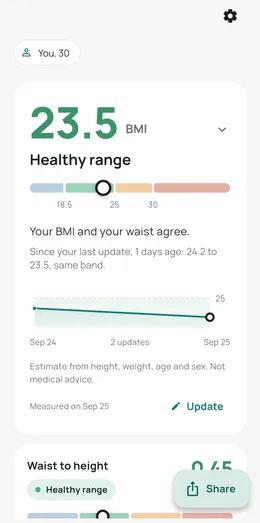
The app shows the same number, and puts the caveats on the same screen rather than in a footer nobody reads. It also compares your BMI with your waist and tells you when the two disagree.
Before you act on that number, readwhat BMI can and cannot tell you. It misreads about one adult in three.


Free, no account, and it works offline. 100,000+ downloads on Google Play.
Common questions
How is BMI calculated?
Weight in kilograms divided by height in metres squared. Someone who is 70 kg and 1.70 m has a BMI of 70 divided by 2.89, which is 24.2. That is the whole formula; there is nothing else in it, which is both why it is useful and why it is limited.
What are the BMI categories?
The WHO bands for adults are under 18.5 underweight, 18.5 to 25 healthy, 25 to 30 overweight and 30 or more obese. Lower boundaries of 23 and 27.5 are advised for people of South and East Asian descent, because the same BMI carries more body fat in those populations.
Is BMI accurate for individuals?
It was designed to describe populations, and it does that well. For one person it is a screening number with known blind spots: it cannot distinguish muscle from fat, it ignores where weight sits, it misreads very tall and very short people, and it becomes less reliable with age as height falls and composition changes.
Does BMI work for children?
Not in this form. A healthy BMI changes as a child grows, so children aged 5 to 19 are read against growth curves for their exact age and sex instead of adult bands. The app does this with the WHO 2007 growth reference.
What should I measure instead?
Add a tape measure. Your waist to height ratio tells you where the weight sits, which BMI cannot see, and a waist based body fat estimate tells you roughly how much of you is fat. Neither replaces BMI; together they give a much fuller picture than any of them alone.
Sources
Every figure above comes from one of these. Check them.
- World Health Organization. Body mass index classification for adults
- WHO expert consultation (2004). Appropriate body-mass index for Asian populations and its implications for policy and intervention strategies. The Lancet 363(9403)
- NICE guideline NG246 (2025). Overweight and obesity management
- Rothman KJ (2008). BMI-related errors in the measurement of obesity. International Journal of Obesity 32(S3)
- Trefethen LN (2013). New BMI (New Body Mass Index), University of Oxford, first published as a letter to The Economist, 5 January 2013
- Gadzik J (2006). "How much should I weigh?" Quetelet's equation, upper weight limits, and BMI prime. Connecticut Medicine 70(2), 81-88
This is not medical advice. Body Numbers is a calculator. It does not diagnose, treat or monitor any condition, and no number it produces should replace a conversation with a doctor or a dietitian. If a result worries you, or if you are pregnant, unwell, or under eighteen, speak to a health professional.
