
How accurate are body fat scales?
A body fat scale measures resistance, then guesses fat with an equation you cannot see. What lab comparisons found, scale by scale.
Metabolic age is a number shown by body-composition scales. The makers Tanita and InBody describe it as your estimated basal metabolic rate compared with the average for people of different ages. InBody's own blog says there is no universal formula or database, so two devices can give different answers, and the published studies use it as a research variable, not a clinical measure.
Metabolic age is a number a body-composition scale shows next to your weight and body fat. It is not a lab test and it has no agreed definition. Two scale makers describe it the same broad way: the device estimates how much energy your body uses at rest, then compares that figure with the average for people of different ages. The age whose average matches yours is your "metabolic age".
The clearest descriptions come from the companies that sell the devices, so read them as manufacturer descriptions, not independent findings.
So a device maker states in its own words that the number is built differently from brand to brand. A reading from one scale cannot be compared with a reading from another.
Basal metabolic rate is the energy your body uses at complete rest. Scales do not measure it. They estimate it, and the published equations for estimating it all include age.
The Mifflin St Jeor equation, published in 1990 in the American Journal of Clinical Nutrition by Mifflin, St Jeor and colleagues, was built from 498 healthy adults aged 19 to 78 whose resting energy was measured by indirect calorimetry (measuring oxygen use and carbon dioxide output). The simplified form is:
Weight, height, age and sex together explained 71% of the differences in resting energy between the people in that study. The same paper found fat-free mass on its own explained 64%, more than weight alone (56%). The age term means the equation predicts 5 kcal a day less for each extra year, with everything else held equal.
That is the logic metabolic age borrows. If you know how resting energy relates to age in a reference group, you can ask at what age an average person of the same build would burn the same amount. You can see the Mifflin St Jeor equation worked through on the Mifflin St Jeor equation page, and get your own estimate from the BMR calculator.
This shows the arithmetic of the idea only. It is not how any named scale calculates its figure, because no maker publishes that.
Take a woman who is 40, 165 cm tall and 70 kg. Mifflin St Jeor predicts 10 × 70 + 6.25 × 165 − 5 × 40 − 161 = 1,370 kcal a day. Suppose a device, using its own body-composition estimate, puts her resting energy at 1,420 kcal. Solving the same equation for age, 1,420 kcal is what it predicts for a woman of her height and weight at about 30. A device built on this logic would show "30".
The answer depends on two things: the resting energy estimate the device starts from (a bathroom scale works it out from an electrical reading, not measured oxygen use), and the reference averages it compares against, which InBody says differ between manufacturers.
That electrical reading is also how a home scale estimates body fat; how accurate are body fat scales? reports a 2023 test of fifteen devices in which one home scale read 11.7% too high on average.
A PubMed search for "metabolic age" in titles and abstracts returns studies that take the number straight off a Tanita or other bioelectrical impedance device and test whether it lines up with other health markers. None of the abstracts below defines a formula of its own or checks the device figure against a reference method.
These papers do not even share a definition. One calls it a BMR index, one ties it to fat-free mass, and the 2025 Nutrients paper describes it as the gap between real age and body age. One uses a 45.5-year cut-off, another uses 12 years over real age. Neither cut-off is a standard anyone else follows.
All of the studies above are cross-sectional: they measure people once. They show that a higher device metabolic age tends to go with a larger waist, more body fat or worse scores on other risk scales in the same people. They cannot show that the number predicts what will happen to any one person, or that changing it changes anything else.
They also cannot tell you how close the figure is to the truth: none of these abstracts reports checking it against resting energy measured by calorimetry. And three of the five name a Tanita device, so they say little about the figure on another brand of scale.
If your scale shows a metabolic age, treat it as that device's summary of its own weight, fat and muscle estimates, expressed in years. Taken on the same scale, at the same time of day and in the same conditions, a change over months tells you the device's estimate has moved. Comparing it with a friend's scale, or with a gym's device, tells you very little.
If you want the inputs rather than the summary, the numbers behind it are more direct: an estimate of resting energy from the BMR calculator, and a body fat estimate from the body fat calculator, each naming the published method it uses and its limits. If a reading worries you, a doctor can measure the things metabolic age is loosely linked to, such as blood pressure, blood glucose and blood lipids.
No. No clinical guideline in the sources above defines it, and InBody, a device maker, writes on its own blog that it is not a standardised medical measure. Published studies use the figure their device prints as a research variable. It does not diagnose anything.
Tanita and InBody both describe comparing an estimated basal metabolic rate with average values for different age groups. Neither publishes the equation or the reference data, and InBody says manufacturers use different databases and proprietary algorithms.
Each brand estimates your resting energy from its own body-composition algorithm and compares it with its own reference averages. InBody states there is no universal formula or database, so different devices can give different results for the same person.
You can reproduce the idea with a published equation such as Mifflin St Jeor (Mifflin 1990), by asking at what age the equation would predict your estimated resting energy. The answer is only as good as your resting energy figure, and it will not match any particular scale, because no scale publishes its method.
The studies above found that a higher device metabolic age went with larger waists and worse scores on other risk measures, in the groups they measured at one point in time. That does not make the number a health grade for one person, and no study above shows that lowering it changes your health.
Every figure above comes from one of these. Check them.
A body fat scale measures resistance, then guesses fat with an equation you cannot see. What lab comparisons found, scale by scale.
A normal BMI with a high body fat percentage has a research name. Here is what the 2010 study behind it found, and its limits.
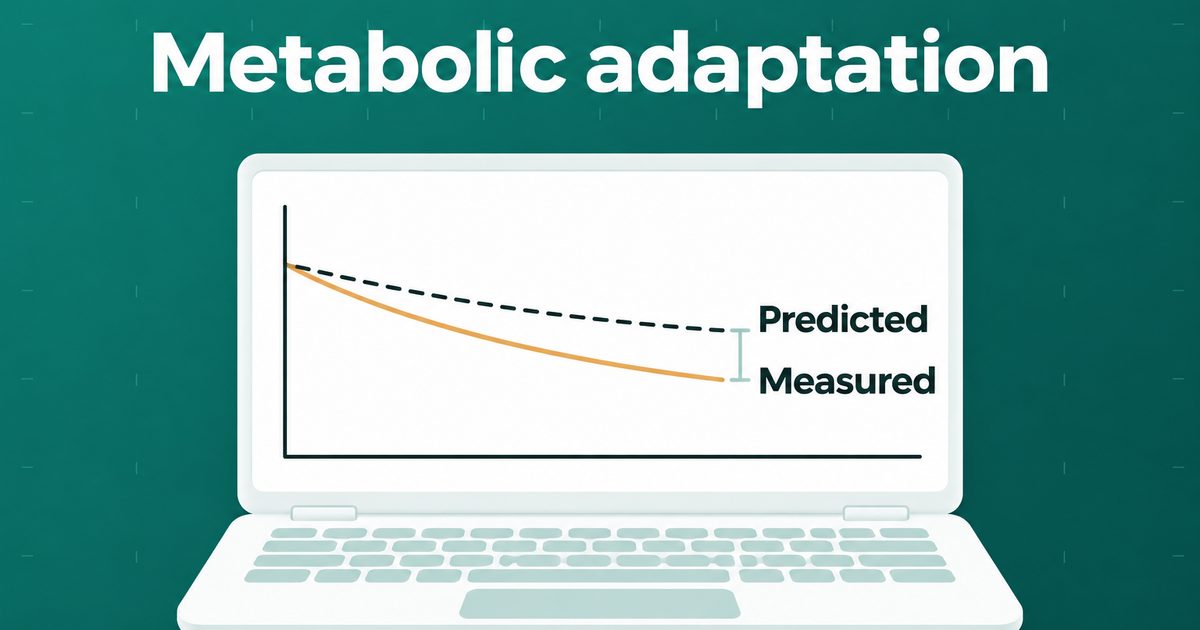
From a 1995 NEJM experiment to The Biggest Loser follow-up: what metabolic adaptation studies measured, and what they cannot tell you.
The app runs body mass index (BMI), waist ratios and three body fat methods side by side, and tells you when they disagree about you.
Free, no account, and it works offline. 100,000+ downloads on Google Play.
This is not medical advice. Body Numbers is a calculator. It does not diagnose, treat or monitor any condition, and no number it produces should replace a conversation with a doctor or a dietitian. If a result worries you, or if you are pregnant, unwell, or under eighteen, speak to a health professional.
 Scan to install